Newport Wolf Appliance Repair Harbor log · Newport Beach, CA

Chart index Newport Wolf Appliance Repair

00

Dispatcher (949) 623-3277 Phone 24/7 · House calls daily, 8 am to 6 pm · $89 per visit, credited

Book a visit

SheetLogbook · hoods and downdrafts

A Wolf hood should go unheard

Nobody notices a healthy hood. It swallows the steam off a stockpot and the smoke from a seared steak and barely makes itself heard doing it. Once it starts roaring, rattling or letting smoke drift toward the ceiling, the fan assembly, its filters or its switches have slipped, and near the harbor, grease and salty air usually helped it along.

4.8 of 5 from 187 reviews About this rating

Logged reply1 / 3

Where do I get a Wolf range hood repaired near Newport Beach?

Newport Wolf Appliance Repair services Wolf wall-mount, island, liner-style and downdraft ventilation in Newport Beach and ten nearby Orange County communities: blowers, motors, switches, lighting and filters. Reach us at (949) 623-3277 at any hour; visits go out from 8 to 6 daily. You're charged $89 a single time per trip, and it is subtracted from the repair invoice.

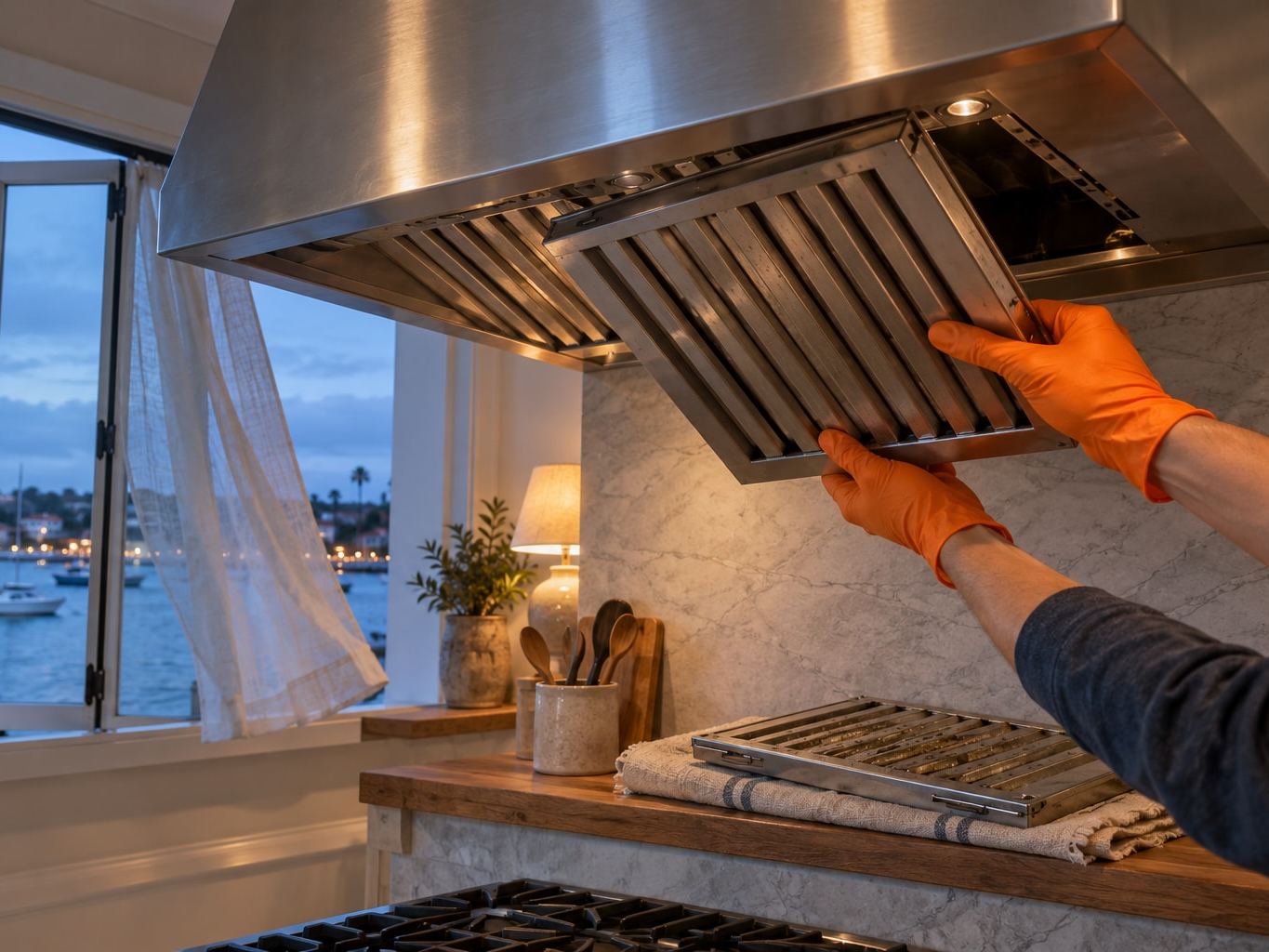
Technician in orange gloves sliding a baffle filter out of a stainless Wolf wall hood, a second filter on a folded cloth on a teak shelf and a casement window open onto the harbor at dusk

Entry 01 Signs & causes

When the hood stops being quiet

Listen and look before calling; each clue leads to its own component.

  • Observed

    Every speed now sounds like a jet engine instead of a soft rush

    Probable cause

    An uneven crust of grease on the fan wheel, or motor bearings going dry

  • Observed

    A rattle or buzz that quiets when you press a palm on the canopy

    Probable cause

    A baffle filter not seated, a loose panel screw, or a damper flap chattering in the duct

  • Observed

    Smoke slips around the canopy and hangs under the ceiling

    Probable cause

    Clogged baffles, a damper flap jammed half closed, or a blower mounted elsewhere that has quit

  • Observed

    Press the fan control and nothing happens

    Probable cause

    Switch or control board fault, no power to the hood, or broken wiring to a blower mounted elsewhere

  • Observed

    Lights dead, dim or flickering while the fan works

    Probable cause

    Bulb, holder, or the light output on the board; salty air eats at contacts

  • Observed

    Fan starts by itself, or won't switch off

    Probable cause

    Certain hoods switch themselves on when they detect high heat underneath, which is expected; if not that, a sticking switch or board

  • Observed

    Downdraft vent won't rise or lower

    Probable cause

    Lift motor, its drive, or something wedged in the slot

  • Observed

    Grease dripping onto the cooktop

    Probable cause

    Filters saturated, or a grease trough that hasn't been emptied

Entry 02 Table

Hood styles and where each one wears

Wolf builds ventilation in a handful of formats. What tires out depends on where the fan and its switches are housed.

Table 1Ventilation style against wear points and what owners notice

StyleWhere it sitsParts that wearWhat you notice
Wall hoodMounted to the backsplash wall over a range or rangetopFan assembly, baffles, lamps, switchesNoise, weak draw, lights out
Island hoodSuspended over an island cooktopSame parts, often a longer duct runVibration, weaker capture at the edges
Hood liner or insertHidden inside a custom wood or plaster hoodBlower, filters, lights, controls behind a panelNoise and lighting faults; access through the cabinetry
DowndraftPops up out of the countertop at the back of the cooktopLift motor, blower in the base cabinet, filterWon't rise, weak pull, grinding
Remote or in-line blowerSomewhere along the duct, in the attic, or on an exterior wallMotor and the wiring back to the hoodHood controls light up but no air moves

Entry 03 Side by side

Filter trouble or blower trouble?

Plenty of loud or feeble hoods simply need clean filters. Others have a failing fan. These clues separate the two.

Option A

Likely the filters

  • Draw improves noticeably with clean filters
  • Rattle stops when the filters are reseated
  • Grease drips from filter edges
  • The fan note is steady, just strained

Option B

Likely the blower

  • Noise stays even with clean filters in place
  • Grinding, squealing or a wobble you can hear
  • Speed changes make little difference to the pull
  • The motor hums but the wheel turns slowly or not at all

Entry noteDeal with the filters before anything else. A hood that keeps roaring or barely pulls afterward needs its fan housing opened.

Entry 04 Checklist

Filter care as the manual intends

Whatever your model's manual says overrides this; treat it as the broad routine.

  • Dig out the manual for your hood, since method and interval vary from model to model.
  • Wait until the canopy and baffles are cool to the touch.
  • Lift and tilt the baffle filters out the way the guide shows; don't pry them.
  • Soak and scrub in hot, sudsy water, or run them through the dishwasher where the manual permits, then air-dry fully.
  • Empty and wipe the drip channel on models that include one.
  • Polish stainless along its grain with an approved cleaner; at the coast, remove salt haze along with the grease.
  • Refit the filters so each one sits flat; a gap lets grease past and can rattle.
  • Never spray cleaner into the control buttons or the light sockets.

Entry 05 Notes

Grease plus salt air: why coastal hoods work harder

Every hood fights grease. Fat carried in cooking vapor settles on baffles, on the fan wheel and along the ductwork. The filters are there to catch most of it, but whatever slips past builds up on the wheel, and a wheel carrying an uneven coat of grease spins out of balance and gets loud.

Near the ocean there is a second ingredient. Air off the water carries salt and moisture into the kitchen and up the duct. Grease holds that salt against metal, so screws, damper hinges, light sockets and switch contacts corrode sooner than they would inland. Evenings when the marine layer rolls in add damp to the mix.

The outside matters too. The termination cap on the roof or siding takes the onshore wind head-on. When its flap seizes, the fan is shoving air at a shut gate, and smoke stays in the kitchen at any speed.

What helps: switch the hood on whenever something is cooking on the range or cooktop, not only for heavy searing; keep baffles clean; buff the salt haze off the steel; and mention a sticky outside flap when you call. If the wall oven vents up into the same space, note that too.

Entry 06 Local bearings

Hood repair along the coast and inland

Conditions change from the harbor to the inland towns. Each page covers hoods in that area.

Logged reply2 / 3

Why is my Wolf vent hood fan so noisy?

Three sources explain most of it: baffles sitting loose or clogged, a fan wheel unbalanced by built-up grease, or motor bearings that have worn. Start by cleaning the baffles and pressing them home. Still roaring, grinding or wobbling at all speeds? Then the fan housing has to come open.

Entry 07 Cost factors

Hood repair pricing, broken down

Diagnosis first, then a number, then work, and the $89 paid for the trip is subtracted. Details are on our pricing page.

Where the blower lives
A fan housed in the canopy is serviced from underneath; one mounted in the attic or out on the siding takes extra effort to reach.
Hood style
A liner inside custom cabinetry may need trim panels removed before the parts can be reached.
What failed
A lamp, a switch, a control board and a motor are very different repairs.
Height
Island hoods under tall ceilings need a safe working setup.
Duct and outside cap
When the fault sits in the ductwork or the exterior cap instead, the technician explains the finding and what fixing it means.

Logged reply3 / 3

What makes the lights on a Wolf hood stop working?

Check the light setting and the breaker first. With the fan working and the lamps dark, the fault is the bulb, its holder or the light output of the control board, and close to the water corrosion on those contacts is common. Bulb changes vary between models; check the manual or let a technician do it.

Entry 08 Questions

Ventilation questions owners ask

Is my hood pulling enough air?

Watch steam from a pot on high with the fan on its top speed. If it drifts past the edges, cooking smells linger, or a sticky film forms on nearby cabinets, the hood isn't capturing enough.

Is it okay to cook while the hood isn't working?

Light cooking, yes. Searing and high-heat cooking will push heat, steam and grease into the room and onto cabinets, and gas burners also produce combustion gases the hood would normally carry out. Get it repaired soon.

Do Wolf baffle filters need replacing?

Most are stainless and meant to be cleaned rather than replaced. A filter that is bent and won't sit flat should be replaced, because grease gets past the gap.

Why does my hood fan turn on by itself?

Some hoods start the blower automatically when they sense strong heat below, as a safeguard. If it happens with nothing cooking, or the fan won't turn off, the switch or control needs checking.

Is the problem in my hood or in the duct?

The technician checks both ends: how the blower performs with the filters out, and whether air leaves at the outside cap. Ductwork beyond the canopy may call for a different trade, and you'll hear exactly what the inspection showed.

Could the technician check my cooktop during the hood visit?

Of course. One $89 covers the house call no matter how many appliances are examined; separate repairs get separate quotes. Our rating and how it was carried over are on the reviews page.