Newport Wolf Appliance Repair Harbor log · Newport Beach, CA

Chart index Newport Wolf Appliance Repair

00

Dispatcher (949) 623-3277 Phone 24/7 · House calls daily, 8 am to 6 pm · $89 per visit, credited

Book a visit

SheetLogbook · built-in ovens

Wolf wall ovens that lie about heat

A Wolf built-in oven rarely dies in one go. More often it starts fibbing: the display claims it is ready while the cake says otherwise. This page walks through what should happen between pressing start and sliding the tray in, so you can spot where your oven drops the thread, then ring us or book a slot.

4.8 of 5 from 187 reviews About this rating

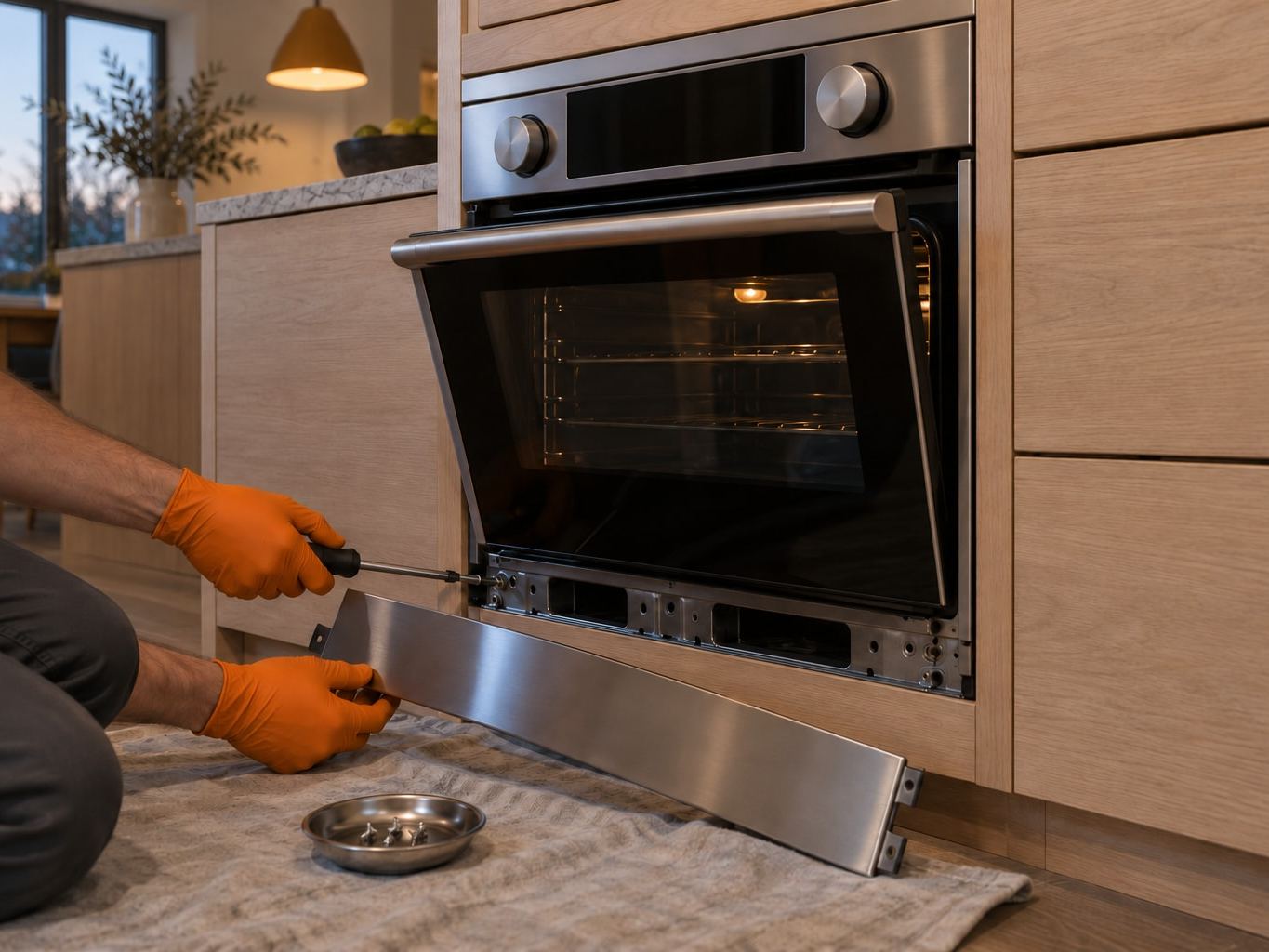
Technician in orange gloves removing the lower trim panel of a Wolf wall oven with a screwdriver, the oven set in pale oak cabinetry, screws in a dish on a canvas drop cloth

Logged reply1 / 3

Is there a Wolf oven repair service in Newport Beach?

Yes: Newport Wolf Appliance Repair services Wolf built-in ovens, whether one cavity, two, or paired with another appliance, across Newport Beach and ten surrounding Orange County towns. (949) 623-3277 is staffed around the clock; house calls go out between 8 and 6, daily. A flat $89 applies per house call rather than per cavity, credited against the repair.

Entry 01 Sequence

Preheat, step by step, when nothing is wrong

Wolf wall ovens are electric. Knowing the normal sequence makes the broken step easy to spot.

  1. Start pressed

    The control reads the chosen mode and target and checks its own temperature sensor. A sensor reading open or shorted usually makes the oven refuse to heat and post a message rather than cook blind.

  2. Heat on

    Whatever elements the mode calls for are switched on. Choose a convection setting and the back-wall fan joins in. A separate cooling fan begins blowing across the electronics; it is the gentle whoosh you sometimes hear after the oven is off.

  3. Climbing

    The sensor keeps reporting cavity temperature back to the control, which holds the elements on until the target gets close.

  4. Ready signal

    The oven announces it has arrived. From then on the control pulses heat in short bursts to hold the setting; a thermometer inside swings gently around the number, and that swing is normal.

  5. Food in

    Opening the door costs heat, and the oven recovers. In convection modes the fan spreads that heat across every rack, which is why three trays can brown alike.

  6. Switched off

    Elements go quiet while the cooling fan carries on until the circuitry is cool. A fan that never stops on a cold oven, or never starts at all, is a fault in its own right.

Entry 02 Signs & causes

Oven behavior, decoded

  • Observed

    Preheat crawls, or the ready signal never arrives

    Probable cause

    One element has opened, so the oven heats on whatever is left; less often a sensor reading high and shutting the heat down early

  • Observed

    Tops scorch while bottoms stay pale, or the reverse

    Probable cause

    Bake or broil element weak or dead, so only one side of the cavity is doing the work

  • Observed

    Convection selected, but the rear fan stays still or grinds

    Probable cause

    Fan motor bearings worn, a blade rubbing, or the circuit that powers the fan

  • Observed

    An independent thermometer disagrees with the display, every time, by a similar margin

    Probable cause

    Sensor drifting or a calibration offset that needs resetting

  • Observed

    Dark display, keys that ignore you

    Probable cause

    Supply interrupted at the breaker, or a surge has taken out the board that runs the oven

  • Observed

    Door stays locked after self-clean has finished and cooled

    Probable cause

    Lock motor or lock switch; never force the door

  • Observed

    Warm air or steam escaping above the door

    Probable cause

    Gasket flattened or torn, or worn hinges letting the door hang crooked

Entry 03 Side by side

Recalibrate, or replace the sensor?

When an oven bakes off target there are two honest fixes. The technician should prove which one applies before charging for either.

Option A

Calibration offset

  • Oven heats, cycles and holds, just at the wrong number
  • Sensor resistance reads within specification at room temperature
  • Offset set in the control so display and cavity agree again
  • No parts involved

Option B

New temperature sensor

  • Reading jumps around, drifts mid-bake, or shows open or shorted
  • Messages appear, or the oven refuses to heat
  • Sensor out of specification against a reference
  • Calibration checked again after fitting

Entry noteMeasure first. A healthy sensor means an offset is the whole job; recalibrating a failing one only hides the fault until it worsens.

Entry 04 Index

Wall oven service in each of our eleven areas

Logged reply2 / 3

What stops a Wolf wall oven from heating to temperature?

Most often an element has failed, leaving the oven to heat on what remains so it never reaches the set point, or the sensor reports a false number and the control stops short. A power or control fault is rarer. A technician meters each element and checks the sensor against a reference thermometer before anything is replaced.

Entry 05 Table

Oven modes and the parts each one leans on

Mode names vary between models, but the hardware behind them is consistent. If only one mode misbehaves, this narrows the search.

Table 1Mode against heat source and the fault clue it leaves

ModeHeat sourceAlso has to workClue when it fails
BakeBottom element, assisted by the top one while preheatingSensor, control relaysLong preheat, pale undersides
BroilUpper elementControl relay for that elementNo browning on top
Convection modesRear fan plus its own element, sometimes with the othersFan motor, sensorUneven racks, fan noise, slow results only in these modes
Self-cleanElements at very high heatDoor lock and its switch, sensorDoor stays locked, message after the cycle
Low-heat modes such as proofing or warmingShort element pulsesSensor accuracy at low settingsDough overproofs, plates come out too hot or too cool

Entry 06 Checklist

Five minutes before you phone

No tools required, and each item trims time off the appointment.

  • Write down which mode and setting you were using when it misbehaved.
  • Check the oven's breaker in the panel; built-in ovens normally run on a dedicated circuit.
  • Put a standalone thermometer at the center of the cavity and jot down what it shows after the ready signal, if the oven gets that far.
  • Write out any wording the display shows, letter for letter.
  • In a convection mode, listen for the rear fan; after switching off, listen for the cooling fan.
  • With two cavities, record whether the upper, the lower, or both misbehave.
  • Snap a photo of the label carrying model and serial; open the door and look around the frame of the cavity.

Entry 07 Cost factors

What shapes the repair figure

A figure is given once the oven has been diagnosed and before anything is touched, less the $89 already paid. The reasoning is laid out on the pricing page.

Which part failed
Swapping an element and replacing a control board sit at opposite ends of the scale; sensors and fan motors fall between.
Calibration only
An offset adjustment needs no parts at all.
Oven configuration
In a double oven, or one stacked with another appliance, some parts are only reachable once the unit is eased out of its housing.
Cabinetry around it
Custom panels and stone need careful handling whenever an oven is drawn forward.
Ordered parts
Should a component need ordering, a return trip gets scheduled, and that is said up front.

Logged reply3 / 3

Why is my Wolf convection fan not working?

When the back-wall fan stays motionless on a convection setting, suspect its motor, the wiring to it, or the relay switching it. When it spins yet racks bake unevenly, the element wrapped around the fan may have failed. Grinding or squealing points to tired motor bearings. All three are repairable.

Entry 08 Questions

Oven owners' questions, answered

Do I have to clean the oven before the technician comes?

No. Take out food, baking stones and pans so the cavity is clear. Skip self-clean right before the visit: a hot oven cannot be worked on, and a fresh cycle can hide what was going on. For rack positions, steam pans and the warming drawer, see loading a Wolf oven.

Can my Wolf oven be fixed the same day I call?

Same-day happens whenever the schedule has room; ask the dispatcher at (949) 623-3277. Where a component must be sourced, the job finishes on a follow-up trip, and you are told before the technician leaves.

My oven is off, so why is a fan still blowing?

That is the cooling fan shielding the circuit boards from leftover heat, and it stops once they are cool. It is worth a call only if the fan keeps going on a cold oven or never runs.

Could pulling out my wall oven scratch the cabinets?

Ovens are only pulled forward when the repair needs it, with the trim and floor protected. Plenty of jobs, sensors, fans and door hardware among them, are done with the oven in place.

My cooktop acts up too. One trip for both?

Absolutely. $89 buys the trip regardless of appliance count; quotes are then given per repair. Read about cooktops, ranges and hoods, or see our rating on the reviews page.